At a Glance: H-1B1 Key Facts
EXECUTIVE SUMMARY:
- What It Is: The H-1B1 is a specialty occupation work visa created under the U.S.-Singapore Free Trade Agreement, available exclusively to Singapore nationals. It allows a Singaporean professional to work in the United States for a U.S. employer in a qualifying specialty occupation – one that requires at minimum a bachelor's degree (or equivalent) in a specific field.
- Who It Is For: Singapore citizens employed by a U.S. company in a specialty occupation role (e.g., engineers, software developers, financial analysts, management consultants, disaster relief claims adjusters). No lottery. No USCIS petition required. You apply directly at the U.S. Embassy in Singapore.
- Duration of Stay: The H-1B1 is initially granted for one (1) year.
- Renewals: Extensions are granted in one (1) year increments, with no six-year cap – meaning you can keep renewing indefinitely. However, every third extension will require a new three-year Labor Condition Application (LCA), because after the second extension, the next extension may only be granted if the Secretary of Labor certifies that the intending employer has filed a new three-year LCA.
- No Lottery, No Wait: Unlike the H-1B, the H-1B1 is not subject to the annual cap lottery. Singapore nationals have their own dedicated annual allocation of 5,400 visas.
- Grace Period: If your H-1B1 employment ends, you get a 60-day grace period (or the remaining validity of your authorised stay, whichever is shorter) to find a new employer, apply for an extension, or change status.
Why the Cover Letter Is Your Roadmap
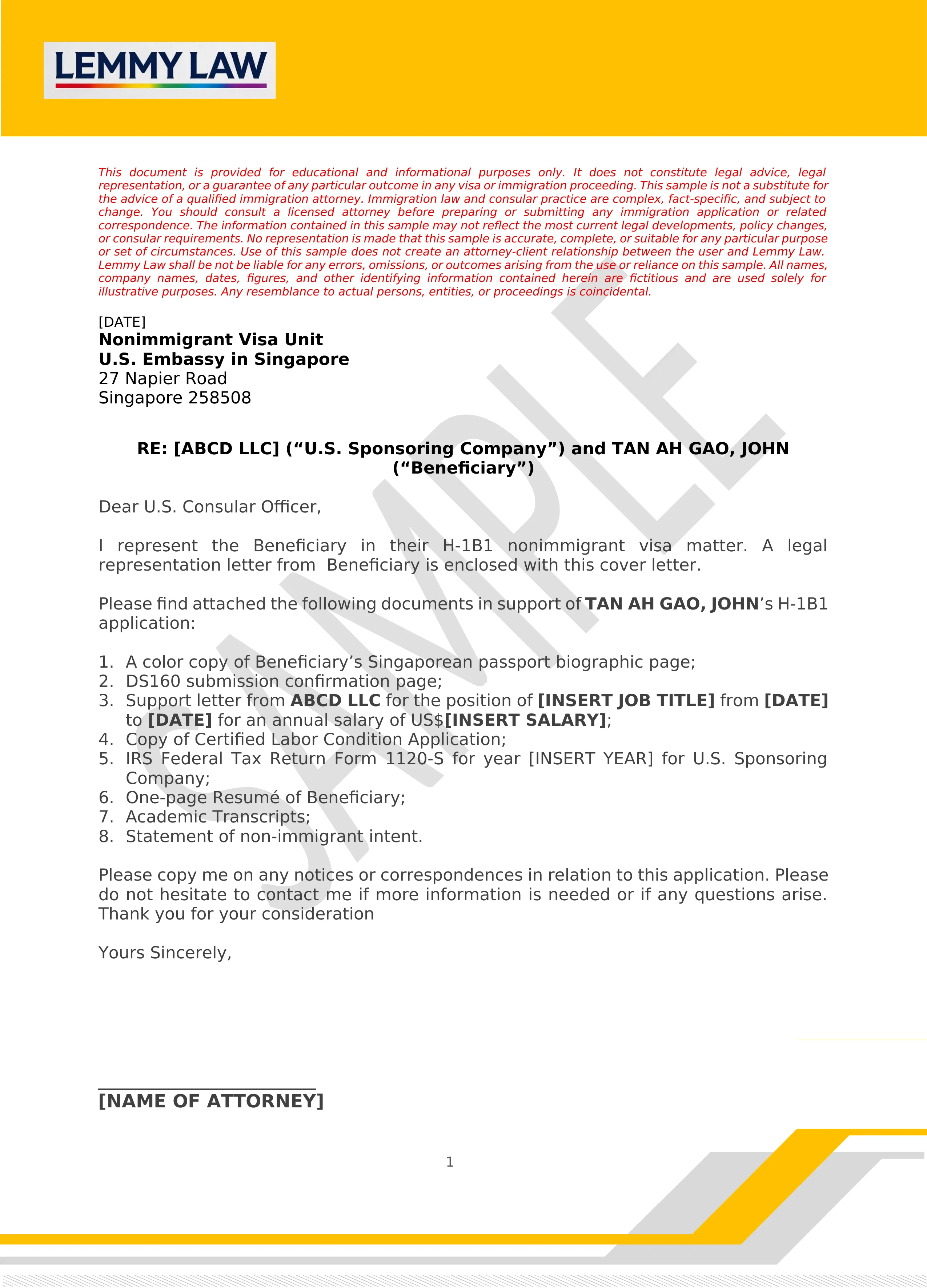
The attorney cover letter submitted to the U.S. Embassy is essentially a checklist of the key things you need to prove to get your visa approved. Each item on that list exists for a specific legal reason, and once you understand why it's there, the whole application process clicks into place.
Here is what each item mentioned in the cover letter does and why it matters.
Breaking Down Each Supporting Document
1. Colour Copy of the Applicant's Singaporean Passport Biographic Page
Why it's there: The H-1B1 is a treaty visa available only to citizens of Singapore (and Chile). The passport biographic page is the foundational proof of nationality – it is there to prove to the consular officer that the applicant is eligible for this visa category in the first place. This is document zero: everything else rests on it.
2. DS-160 Submission Confirmation Page
Why it's there: The DS-160 is the mandatory online nonimmigrant visa application form that every visa applicant must complete before their consulate interview. The confirmation page proves the form has been submitted. Consular officers often begin reviewing your case from the DS-160 even before you walk in for your interview – it is their first look at you. Experienced practitioners advise using every available free-text field in the DS-160 strategically, because consular officers will at minimum skim it.
3. Support Letter from the U.S. Sponsoring Company
Why it's there: Unlike the H-1B, the H-1B1 does not require the U.S. employer to file an I-129 petition with USCIS. Instead, the employer submits a written offer of employment directly to the consulate. This support letter is that written offer. It must confirm the position (job title), the period of employment (start and end dates), and the annual salary. This document establishes the core employment relationship: the "who, what, when, and how much" of the job. Without it, there is no visa.
4. Copy of the Certified Labor Condition Application (LCA)
Why it's there: Before any H-1B1 can be approved, the U.S. employer must file a Labor Condition Application (LCA) with the U.S. Department of Labor and have it certified. The LCA is the employer's formal attestation to the government that: (a) the wage offered meets or exceeds the prevailing wage for that occupation in that geographic area; (b) working conditions will not adversely affect other workers; and (c) there is no strike or lockout at the worksite. The LCA must be annotated specifically as "H-1B1 Singapore." Without a certified LCA, the visa simply cannot be issued. This document protects both the worker and the U.S. labour market.
5. IRS Federal Tax Return (Form 1120-S) for the U.S. Sponsoring Company
Why it's there: This document serves as proof that the sponsoring U.S. company is real, operational, and financially viable. A consular officer needs to be satisfied that the employer is a legitimate business that can actually employ and pay the applicant. The tax return – IRS Form 1120 – is one of the most credible ways to demonstrate this. It shows revenue, business activity, and that the company has been filing its obligations with the IRS.
6. One-Page Résumé of the Applicant
Why it's there: The H-1B1 requires the applicant to be working in a specialty occupation – a role that requires the theoretical and practical application of a body of specialised knowledge, and at minimum a bachelor's degree in a specific field. The résumé gives the consular officer a quick snapshot of the applicant's professional background, career history, and relevant experience. It helps the officer connect the dots between the applicant's qualifications and the job being offered. Think of it as the human element of the application – it tells the applicant's professional story in a single page.
7. Academic Transcripts
Why it's there: Because the specialty occupation requirement demands a minimum of a bachelor's degree in a relevant field, the applicant must prove they actually hold that degree. Academic transcripts from the applicant's university serve as the authoritative verification of their educational credentials – the degree earned, the field of study, and the institution. This is the document that closes the loop on the "are you qualified?" question. If the applicant has a degree from a foreign university, this document is especially critical.
8. Statement of Non-Immigrant Intent
Why it's there: This is one of the most important and often least understood documents in the entire application. The H-1B1 is subject to INA §214(b), which means the applicant is presumed to be an intending immigrant unless they can prove otherwise. In plain English: the default assumption is that you want to stay in the U.S. permanently, and it is your job to counter that presumption. The Statement of Non-Immigrant Intent is a signed declaration by the applicant confirming that they do not intend to abandon their foreign residence or become a U.S. permanent resident. Unusually for the H-1B1, the law does not require the applicant to maintain a foreign residence (maintain a home residence outside the United States) – even an intention to emigrate to the U.S. in the future (if not connected to the current trip) is not by itself conclusive evidence of immigrant intent. But without this document, the officer has little to go on.
The Optional: Legal Representation Letter
The cover letter also references an enclosed legal representation letter from the applicant authorising the attorney to act on their behalf and asking the consulate to copy the attorney on all correspondence. While not a substantive document going to the merits of the visa, it is standard practice when an applicant is represented by counsel, and it formally establishes the attorney-client relationship with the consular post.
Ready to Apply?
The H-1B1 is a very accessible pathway for Singaporeans to work in the United States: no lottery, no USCIS petition, and a direct application at the U.S. Embassy in Singapore. But as straightforward as the process looks on paper, each document in that cover letter carries legal weight, and a single misstep can result in a denial.
At Lemmy Law, we focus on H-1B1 applications for Singapore nationals and their U.S. employers. If you are a Singaporean professional with a U.S. job offer, or a U.S. company looking to hire Singapore talent, contact us today for a consultation.