If you hold a Singaporean, Thai, Filipino or Bruneian passport, you have something most of Southeast Asia does not: a treaty-based right to live and run a business in the United States, renewable indefinitely, with no lottery, no quota and no employer sponsor.
Indonesians, Malaysians, Vietnamese, Burmese, Cambodians and Laotians have no equivalent route at all. And yet, year after year, the four ASEAN treaty countries leave this privilege almost entirely on the table.
What Is the E-1 Treaty Trader Visa?
The E-1 is for nationals of a treaty country carrying on substantial trade principally between the United States and their home country. "Trade" is broad – goods, services, technology, logistics, banking, insurance, consulting, even data services. There is no fixed dollar minimum; what matters is a real, continuous flow of transactions, with more than half of your international trade running between the U.S. and your home country. The trading company must be majority-owned by nationals of the treaty country, and the visa covers owners as well as essential or supervisory employees of the same nationality.
What Is the E-2 Treaty Investor Visa?
The E-2 is for nationals of a treaty country who invest a substantial amount of capital in a real, operating U.S. business and come to develop and direct it. The investment must be at risk, irrevocably committed and lawfully sourced – a genuine enterprise, not passive property or a stock portfolio. There is no statutory minimum amount, but the business cannot be "marginal": it should be capable of generating more than a living for the investor, typically shown through a credible plan to hire U.S. workers.
Both visas share the features that make them so valuable: unlimited renewals for as long as the trade or investment continues, work authorization for your spouse, and school for your children – all without touching the H-1B lottery or a green card queue.
Which ASEAN Countries Qualify?
| Country | E-1 Treaty Trader | E-2 Treaty Investor | Treaty rights since |
|---|---|---|---|
| Singapore | ✓ Yes | ✓ Yes | 2004 |
| Thailand | ✓ Yes | ✓ Yes | 1968 |
| Philippines | ✓ Yes | ✓ Yes | 1955 |
| Brunei | ✓ Yes | ✗ No | 1853 |
| All other ASEAN countries | ✗ No | ✗ No | – |
Brunei's treaty is one of the oldest on the books – signed in 1853, before the American Civil War. It has never been matched with meaningful uptake.
The Numbers: A Privilege Going Unused
Here is what the U.S. Department of State actually issued in fiscal year 2024:
| Country | E-1 visas (FY2024) | E-2 visas (FY2024) | Total |
|---|---|---|---|
| Thailand | 15 | 490 | 505 |
| Philippines | 4 | 127 | 131 |
| Singapore | 1 | 61 | 62 |
| Brunei | 0 | – | 0 |
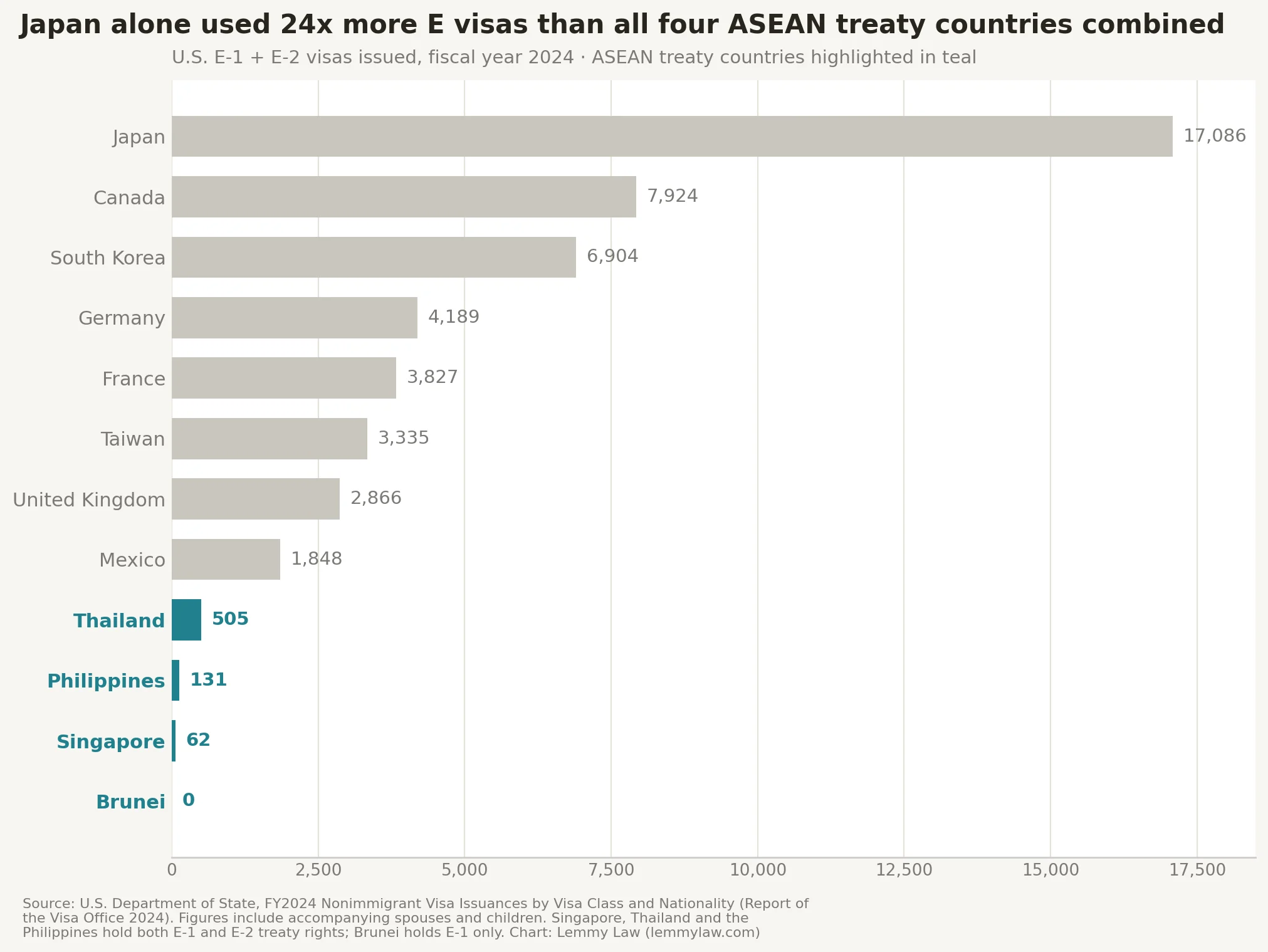
| Four ASEAN treaty countries combined | 20 | 678 | 698 |
Source: U.S. Department of State, Report of the Visa Office 2024, Nonimmigrant Visas Issued by Classification and Nationality, FY2024. Figures include accompanying spouses and children.
Now compare that with other treaty countries in the same year. Japan: 17,086 E visas. South Korea: 6,904. Taiwan: 3,335. Even Mongolia – population 3.5 million – was issued more E-2 visas (82) than Singapore (61).
Read that Singapore line again: exactly one E-1 Treaty Trader visa was issued to a Singaporean in all of FY2024 – from a nation of trading companies whose free trade agreement with the U.S. created the benefit in the first place.
Why Is Uptake So Low?
Not because the visas are hard to get. E visas are adjudicated at the consulate, with no lottery and no annual cap. The gap is awareness. Japanese, Korean and Taiwanese companies have used E visas for decades as standard practice; in ASEAN, most eligible business owners have simply never heard of them – or assume they are reserved for multinationals. In reality, E-1 and E-2 visas are routinely approved for SME owners, franchise buyers, consultants, trading firms and startup founders, provided the trade or investment is real, properly structured and well documented.
Could This Be Your U.S. Pathway?
If you are a citizen of Singapore, Thailand, the Philippines or Brunei and you trade with U.S. counterparties, want to buy or build a U.S. business, or are exploring a move to the United States, you may hold a pathway your regional competitors cannot access at all.
Lemmy Law is a Singapore-based U.S. immigration practice serving clients across the Asia-Pacific. We assess E-1 and E-2 eligibility, structure qualifying businesses and prepare applications built for consular scrutiny – in your timezone. Book a consultation or WhatsApp us, and bring whatever research you've already done. We'll take it from there.
FAQ
Which ASEAN countries are eligible for U.S. E-1 and E-2 visas?
Singapore, Thailand and the Philippines qualify for both E-1 and E-2. Brunei qualifies for E-1 only. No other ASEAN country qualifies.
Is there a minimum investment for the E-2 visa?
No fixed statutory minimum. The investment must be "substantial" relative to the cost of the business, at risk, and sufficient to make the enterprise operational and non-marginal.
Can E-1 and E-2 visas be renewed?
Yes – indefinitely, in two-to-five-year increments depending on nationality, for as long as the qualifying trade or investment continues.
Can my spouse work in the U.S. on an E visa?
Yes. Spouses of E-1 and E-2 visa holders are considered employment-authorized in the United States, and children can attend school.